Algeria and Tunisia Deepen Cooperation with Parliamentary Protocol
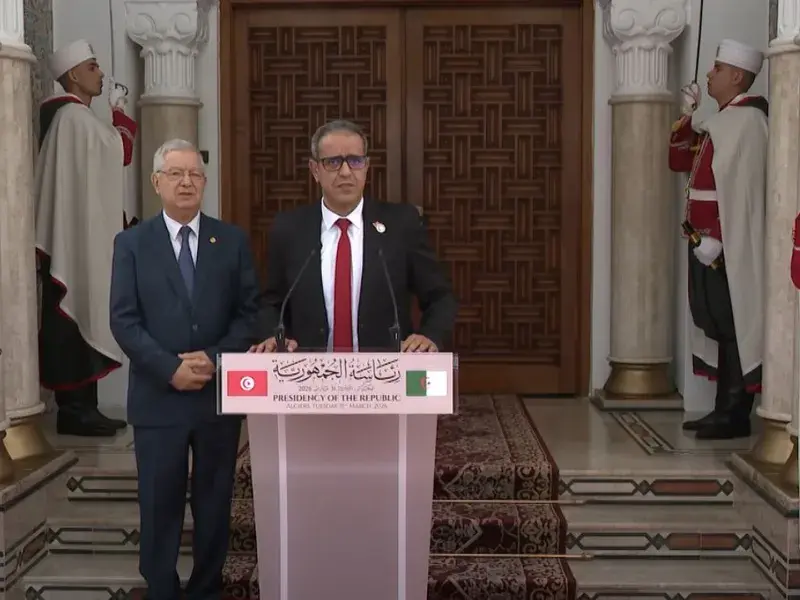
Image: Ennahar
Takeaway
The deepening economic ties between Algeria and Tunisia present opportunities for investors in energy, pharmaceuticals, agriculture, and services. Companies should monitor the development of joint ventures and the expansion of trade in non-hydrocarbon sectors. The push for a comprehensive free trade agreement could further reduce trade barriers and create new market access opportunities.
Algeria and Tunisia are solidifying their bilateral relations through enhanced cooperation across various sectors. On March 31, 2026, President Abdelmadjid Tebboune received Emad Derbali, the President of the National Council of Regions and Districts of Tunisia, in Algiers. The meeting underscored the commitment of both nations to strengthen ties for the mutual benefit of their people.
Historically, Algeria and Tunisia have experienced periods of both cooperation and antagonism since gaining independence from France in 1956 and 1962, respectively. The 1,034 km border between them was officially demarcated in 1960. In February 1989, both countries became founding members of the Arab Maghreb Union, aiming to foster economic integration and free trade within the region. More recently, Algeria has provided financial assistance to Tunisia, including a $150 million deposit in 2020, a $300 million loan in 2021, and a $300 million package in 2022.
The strengthening of parliamentary ties was highlighted by the signing of a parliamentary cooperation protocol between عزوز ناصري, President of the Council of the Nation, and Emad Derbali. This agreement includes the establishment of a forum for parliamentary cooperation, designed to facilitate dialogue, consultation, and mutual support between the two legislative bodies. The 23rd session of the Algerian-Tunisian Joint High Commission for Cooperation convened in Tunis, with Prime Ministers Sifi Ghrieb of Algeria and Sarra Zaafrani Zenzri of Tunisia co-chairing. During this session, several agreements and memoranda of understanding were signed, covering sectors such as water, transport, investment, insurance, youth and sports, diplomacy, and media.
Bilateral trade between Algeria and Tunisia has seen a 42% increase over the past three years, reaching approximately $2.3 billion in 2024. In 2024, Algeria's exports to Tunisia totaled $1.95 billion, with key products including petroleum gas ($1.44 billion), electricity ($294 million), and raw sugar ($82.2 million). Tunisia's exports to Algeria amounted to $545 million in 2024, with primary goods being aluminum cans ($30.3 million), large construction vehicles ($29.2 million), and trailers ($28.5 million). Despite this growth, trade volumes are still below the ambitions of both nations.
Looking ahead, both countries aim to further enhance commercial exchanges and broaden investment opportunities in strategic sectors, including technological development and renewable energies. Enhanced land and air transport services and the resumption of rail links are expected to strengthen people-to-people ties. However, Tunisia's trade deficit with Algeria remains a concern, standing at around $1.64 billion in 2025, making Algeria Tunisia's second-largest trade deficit partner after China.